|
SAIN Records Celebrating its 40th Anniversary with a Grand Concert at the National Eisteddfod of Wales
|
FolkWorld Issue 39 07/2009; Article from Wikipedia, the free encyclopedia
SAIN Records Celebrating its 40th Anniversary with a Grand Concert at the National Eisteddfod of Wales
SAIN Records can probably claim being the biggest Welsh music label,
reflecting the whole spectrum of Welsh music from traditional to hip-hop.
SAIN (i.e. sound) was founded in 1969 by singer-songwriters Huw Jones and Dafydd Iwan.
In the following deacdes, they added folk rock groups like Ar Log and Plethyn,
harmony groups such as The Hennessys,
and iconic individuals like Meic Stevens and Heather Jones to their catalogue.
 SAIN Records is celebrating its 40th birthday with a Grand Concert at the National Eisteddfod
of Wales Pavillion on Monday night, August 3rd in Bala, Gwynedd.
The evening will include performances by some of Wales’ top performers - two of the company’s
founders, Dafydd Iwan and Huw Jones will perform along with other influential artists such as
Hogia’r Wyddfa, Trebor Edwards, Geraint Jarman, Meic Stevens, Heather Jones, Annette Bryn Parri,
Côr Rhuthun, Plethyn, John ac Alun, Calan, Gai Toms, Daniel Lloyd, Gwibdaith Hen Frân and the
John Quirk Band as accompaniment.
There will also be a rare appearance by Ffarmwr Ffowc too!
SAIN Records is celebrating its 40th birthday with a Grand Concert at the National Eisteddfod
of Wales Pavillion on Monday night, August 3rd in Bala, Gwynedd.
The evening will include performances by some of Wales’ top performers - two of the company’s
founders, Dafydd Iwan and Huw Jones will perform along with other influential artists such as
Hogia’r Wyddfa, Trebor Edwards, Geraint Jarman, Meic Stevens, Heather Jones, Annette Bryn Parri,
Côr Rhuthun, Plethyn, John ac Alun, Calan, Gai Toms, Daniel Lloyd, Gwibdaith Hen Frân and the
John Quirk Band as accompaniment.
There will also be a rare appearance by Ffarmwr Ffowc too!
Wales has a strong and distinctive tradition of folk music related to the Celtic music of countries such as Ireland and Scotland. It has distinctive instrumentation and song types, and is often heard at a twmpath (folk dance session), gŵyl werin (folk festival) or noson lawen (traditional party or ceilidh). Modern Welsh folk musicians have sometimes reconstructed traditions which had been suppressed or forgotten, and have competed with imported and indigenous rock and pop trends.
Wales is a country sometimes referred to as "the land of song" and is also traditionally associated with Male Voice Choirs, with choirs such as the Morriston Orpheus Choir and Treorchy Male Voice Choir enjoying a world wide reputation. A tradition of brass bands dating from the Victorian era continues, particularly in the South Wales Valleys, and Welsh bands such as the Cory Band are amongst the finest in the world. There is also a thriving modern musical scene which spans several genres and two languages.
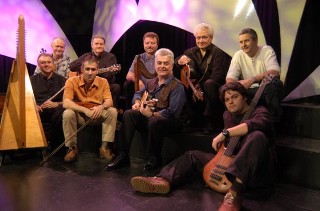
Ar Log @ FolkWorld: FW #20, #20, #35
|
Welsh traditional music declined somewhat with the rise of Nonconformist religion in the 18th century, which emphasised choral singing over instruments, and religious over secular uses of music; traditional musical styles became associated with drunkenness and immorality.
In the 1860s, however, a revival of sorts began, with the formation of the National Eisteddfod Society, followed by the foundation of London-area Welsh Societies and the publication of Nicholas Bennett's Alawon fy Ngwlad ("Tunes of my Land"), a compilation of traditional tunes, in the 1890s.
By the late 1970s, Wales, like many of its neighbours, had seen the beginning of a roots revival, the beginnings of which can be traced back to the 1960s folk singer-songwriter Dafydd Iwan. Iwan was instrumental in the creation of a modern Welsh folk scene, and is known for fiercely patriotic and nationalistic songs, as well as the foundation of the Sain record label. The Festival Interceltique de Lorient saw the formation of Ar Log, who spearheaded a revival of Welsh fiddling and harp-playing, and continued recording into the 21st century. A Welsh session band, following in the footsteps of their Irish counterparts Planxty, Cilmeri recorded two albums with a uniquely Welsh feel. Welsh folk rock includes a number of bands, such as Moniars, Gwerinos, Blue Horses, Bob Delyn a'r Ebillion and Taran.
Sain was founded by Iwan, Brian Morgan Edwards and Huw Jones. Originally, the label signed a bevy of Welsh singers, mostly with overtly political lyrics, eventually branching out into a myriad of different styles. These included country music (John ac Alun), singer-songwriters (Meic Stevens), stadium rock (The Alarm) and classical singers (Aled Jones, Bryn Terfel).
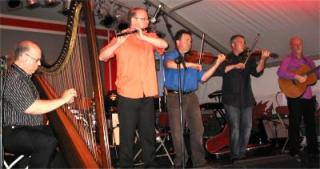
Crasdant / Robin Huw Bowen @ FolkWorld:
|
In June 2007, Tŷ Siamas opened its doors in Dolgellau. Tŷ Siamas is the National Centre for Traditional Music, with regular sessions, concerts, lessons, an interactive exhibition and a recording studio.
The Welsh triple harp (telyn deires) is a type of harp using three rows of strings instead of the common single row. The Welsh triple harp today is found mainly among players of traditional Welsh folk music.
The triple harp first originated in Italy and appeared in the British Isles early in the 17th century. In 1629, the French harpist Jean le Flelle was appointed ‘musician for the harp’ at the King's court. Flelle played the Italian triple harp with gut strings.
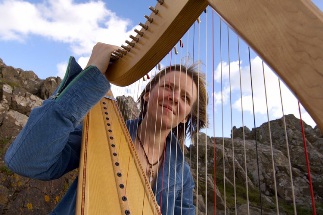
Gwenan Gibbard @ FolkWorld: FW #34
|
The triple harp was quickly adopted by the Welsh harpers living in London during the 17th century. It was so popular that by the beginning of the 18th century the triple harp was generally known as the "Welsh harp". Charles Evans was the first mentioned Welsh triple harpist. He was appointed harper to the court in 1660, where his official title was ‘His Majesty's harper for the Italian harp’.
A description of the Welsh triple harp is given by the harpist John Parry (Bardd Alaw) (1776–1851) in the preface to the second volume of his collection, The Welsh Harper (London 1839):
The compass of the Triple Harp, in general, is about five octaves, or thirty-seven strings in the principal row, which is on the side played by the right hand, called the bass row. The middle row, which produces the flats and sharps, consists of thirty-four strings; and the treble, or left hand row, numbers twenty-seven strings. The outside rows are tuned in unison, and always in the diatonic scale, that is, in the regular and natural scale of tones and semitones, as a peal of eight bells is tuned. When it is necessary to change the key, for instance, from C to G, all the Fs in the outside rows are made sharp by raising them half a tone. Again, to change from C to F, every B in the outside rows is made flat, by lowering it a semitone. When an accidental sharp or flat is required, the performer inserts a finger between two of the outer strings, and finds it in the middle row. Many experiments have been made, with a view of obviating the necessity of tuning the instrument every time a change in the key occurred. Brass rings were fixed near the comb, but those rattled and jarred; in short, every attempt failed until the invention of the Pedals. …
The skill of harp making in Wales had all but been lost for some 60 years until John Weston Thomas (MBE), a talented wood and metal worker, revised the craft, making celtic, chromatic and triple harps until his death in 1992. He passed on his skills to three apprentices: Allan Shiers, Brian Blackmore and Alun Thomas, his son. Alun still makes triple and celtic harps in his workshop just outside of Fishguard. Brian Blackmore also makes triple harps, whilst Allan Shiers went on to make concert harps and found Telynau Teifi Harps.
Among the most important and characteristic playing techniques for the Welsh triple harp is that of unisons. The effect of unisons is obtained by playing the same note on both the outside rows using the right and left hands in rapid succession. Thus a progression of e.g., C-D-F-E, is achieved by playing CC-DD-FF-EE.
After the early 20th century, triple harps were almost completely abandoned in Wales in favour of the modern pedal harp. Preservation of the instrument and the playing style has been attributed to Nansi Richards (1888–1979), who learnt to play from Gypsy harpists in the Bala area at the turn of the century.
Today's leading exponents of the triple harp include Robin Huw Bowen and Llio Rhyderch.
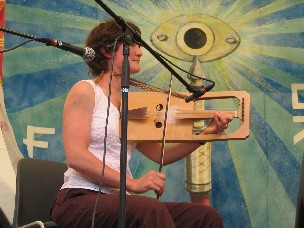
The crwth is an archaic stringed musical instrument, associated particularly with Welsh music, although once played widely in Europe.
Crwth is originally a Welsh word, in English pronounced /ˈkruːθ/ (rhyming with "tooth") or /ˈkrʊθ/. The traditional English name is crowd (or rote), and the variants crout and crouth are little used today. In Medieval Latin it is called the chorus or crotta. The Welsh word crythor means a performer on the crwth. The Irish word is cruit, although it also was used on occasion to designate certain small harps. The English surnames (family names) Crowder and Crowther denote a player of the crowd, as do the Scottish names MacWhirter and MacWhorter.
A variety of string instruments so designated are thought to have been played in Wales since Roman times at least. Continuous, clear records of the use of crwth to denote an instrument of the lyre (or the Byzantine bowed lyre) class date from the 11th century. Medieval instruments somewhat resembling the crwth appear in pictures (first in Continental Europe) as far back as the 11th century, shortly after bowing was first known in the West. In Wales, the crwth long took second place to the harp in the musical hierarchy.
The Welsh word, derived from a Proto-Celtic noun *krotto- meaning "round object", refers to a swelling or bulging out, of pregnant appearance, or a protuberance, and it is speculated that it came to be used for the instrument because of its bulging shape. Other Celtic words for violin also have meanings referring to rounded appearances. In Gaelic, for example, "cruit" can mean harp or violin as well as "hump" or "hunch".
Possible ancestors of the crwth are the lyre of the classical antiquity and the bowed Byzantine lyre of the 9th century. The modern crwth appears to date from only the late 15th or early 16th century and almost surely is not, as some romanticized accounts imply or declare, the same instrument that was played by the ancient and Medieval Welsh bards. In fact, its close ancestors became instruments of the folk culture of Wales and the West Country and West Midlands following the demise of minstrelsy in Britain at the close of the Middle Ages; and in its final form (probably emerging ca 1485-1510), it seems to have been confined to Wales. Although the modern crwth bears something of a resemblance to the classical lyre, with the addition of a bow, it is more closely related to the various plucked and bowed square and round lyres that drawings, paintings, and sculptures show to have existed throughout northern Europe from as far back as the 8th century. While the Middle-Eastern origin of the early European chordophone bow seems beyond dispute, the connections between the European round and square lyres and Middle-Eastern and Classical prototypes are tenuous at best.
The instrument in its final form lingered on in Wales much later than elsewhere, but had gone completely out of fashion by the 18th century, or at the latest the early 19th, supplanted by the more versatile and powerful fiddle (violin). The crwth received its death-blow during the rise of Welsh evangelical Protestantism in the 1730s, when dancing and musical instruments associated with dance music came to be widely condemned. According to the National Library of Wales, records of the last traditional crwth player, John Morgan, are found in Newborough, Anglesey, around 1740. An unconfirmed account reports that one James Green, of Bron y Garth, was actually the last of the traditional players, and that he died in 1855. Other accounts in oral tradition maintain that among the last of the crwth players were Rhys Grythor and Shawms y Crythor (both almost certainly nicknames).
There are many carvings, manuscript illustrations, and written descriptions of crwth-like instruments, but so complete was the abandonment of the modern crwth in the century after about 1735 that only three 18th-century Welsh examples survive. These are held at the National Library of Wales in Aberystwyth, the Museum of Welsh Life at St Fagans, or Sain Ffagan, near Cardiff, and Warrington Museum (near Manchester in the North of England). An important reconstruction of an Anglo-Saxon round lyre, a likely early prototype of the crwth, is part of the collection from the Sutton Hoo ship's burial, housed in the British Museum in London. It closely matches many iconographic representations.
The crwth consists of a fairly simple box construction with a flat, fretless fingerboard and six gut strings, purportedly tuned gg´c´c´´d´d´´. It should be noted that the original report of that tuning (Edward Jones, Musical and Poetical Relicks of the Welsh Bards; London: 1784), from which most subsequent others appear to draw their information, uses arbitrary pitch designations for illustrative purposes. Jones also states that the tuning procedure began by tightening the highest string as much as possible without breaking it, subsequently tuning the others to it intervalically. Such was not an uncommon practice in the days before standardized pitch and was, in fact, mentioned in other manuals on string instrument playing.

While Jones's report was widely read and used as the basis of a number of subsequent accounts, and therefore today is often considered to be evidence of a standard tuning, it is more likely that a variety of tunings were experimented with and in some cases employed, as was and still is the case with many other string instruments, particularly those within folk cultures. A second tuning, reported by William Bingley (A Tour Round North Wales; London: 1800), features the drones tuned in octaves, with the strings over the fingerboard tuned in paired fifths rather than seconds. This tuning has been shown to have been more practical than the more widely reported tuning for both the playing of chords and the performance of melodies.
Traditionally the soundbox, or resonator, and a surmounting yoke in the shape of an inverted U (see picture of player), were carved as a single unit from a block of maple or sycamore. The soundboard, or belly, a separate piece (the upper surface, nearest the strings), was most often made of deal or some other soft wood, and the bridge was usually made of cherry or some other fruitwood. Two soundholes, or circular openings about an inch to an inch and a quarter in diameter, were cut into the soundboard to allow pulsating air from the soundbox to escape and strengthen the tone. The two G strings (to use Jones's terminology - see above) ran parallel to the fingerboard, but not over it, so those strings were used as fixed-pitch drones that were usually, if not always, plucked by the player's left thumb. The remaining strings, which were tightened and loosened with metal harp wrest-pins and a tuning key or wrench, were usually bowed with a horsehair and wood bow. One characteristic feature of the crwth is that one leg of the bridge goes through a soundhole (see picture of player) and rests on the back of the instrument (the bottom of the soundbox). Although it has been conjectured that this is a primitive attempt at a sound post, or anima, something the instrument lacks, it is equally likely that it is designed to take some of the downward pressure of the tightened strings off the soundboard. Since that piece is flat, unbraced, and usually made of soft wood, it is much weaker than the belly of a violin.
The crwth can be played on the shoulder like a violin, between the knees like a cello, on the lap held either upright or at a slightly oblique angle across the player's torso against the left shoulder, or braced against the chest, supported with a strap around the player's neck (see picture). While the crwth can be held at the shoulder, it is difficult to work the drones, or bourdons, with it in that position. The sloping bridge strongly suggests that the oblique-upright position across the upper body (which greatly facilitates the plucking of the drones) was often employed to allow the bow to be pulled slightly upward without rubbing against the bridge as it often would have done had the bridge been set straight across the soundboard. The acute angle of the bow to the strings would have produced the harsh, often squeaky, "glassy" sound that practitioners seemed to prefer. However, since the art of crwth-playing died out so completely, and since it was an instrument of the folk culture rather than part of the academic musical world, the exact manner - if, indeed, there ever was one exact manner - in which the instrument was traditionally played, like the tunings employed, will probably never be known for certain.
The tone of the crwth can seem rough compared to that of the modern violin, as well as lacking in power, and the crwth can be played with ease only in what string players refer to as first position, with the left hand at the far end of the fingerboard rather than moving up towards the bridge. However, it is capable of a delicate and gentle sound that goes well with the timbres of the harp and pibgorn (hornpipe). For all its technical limitations, the crwth has great charm, and is much more than a historical curiosity. Research over about the last thirty-five years, and particularly experimentation with tunings, have shown it to have been much more versatile and facile than was once assumed, although it definitely was not a prototype of modern orchestral bowed string instruments, which emerged from an altogether different branch of the complex string family tree. Historically, it represents the logical end of a line of development, not an early stage of another.
A number of modern reconstructions of the crwth have been made; makers include Guy Flockhart, Nial Cain, Hank Taylor and Gerard KilBride. A handful of folk musicians are reviving the tradition of playing this instrument, among them Cass Meurig (who also plays with the groups Fernhill and Pigyn Clust), Bob Evans (Bragod), and Dan Morris (Cilmeri). The repertoire of surviving crwth tunes is very small, although many other traditional tunes can be adapted for the instrument and new tunes are being written for it. It is also used by a number of early music groups including Cancionero. The world's first CD of crwth music, Crwth by Cass Meurig, was released in 2004 by the Fflach:tradd label.
Bagpipes have been documented in Wales since the 10th century. Welsh traditional music declined somewhat with the rise of Nonconformist religion in the 18th century, which emphasised choral singing over instruments, and religious over secular uses of music, and the pipes had disappeared from use in Wales by the late 19th century. In recent years there has been a revival in piping in Wales. This revival led to the formation of a repertoire of Welsh piping tunes, the reconstruction of extinct instruments and the introduction of new instruments based on common European types.
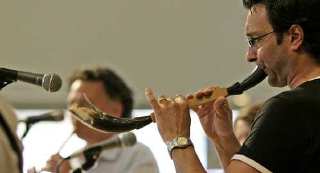
The pibgorn is a reed instrument from Wales. It has a single reed like that found in the drones of traditional Scottish Bagpipes, and generally six finger holes and a thumbhole giving a diatonic compass of an octave. The body of the instrument is made of wood, usually a hardwood in modern examples though historical instruments often had bodies of Elder or bone. At the mouthpiece end is a reedcap made of horn that protects the reed from contact with the players mouth. At the bell end is a distinctively carved horn bell which serves to amplify the sound.
Carreg Lafar @ FolkWorld: FW #9, #23 |
The Welsh pibgorn is mentioned in the laws of Hywel Dda (codified 940–50) which specify that every master employing a pencerdd (chief musician) should give him the necessary harp, crwth and pibgorn. However the instrument is almost certainly older than that, and is part of a pattern of distribution of similar reedpipes that includes the Russian zhaleika, double reedpipes from the Arab world like the Lebanese Mijwiz, the Indian Been or Pungi and the Roman Sambuca.
It is likely that at one time the instrument existed across the British Isles (Robert Burns tried to track down surviving Scottish players) but by the early nineteenth century seemed restricted only to Anglesey. By the late nineteenth century the tradition of playing had been broken.
As part of a general revival in interest in Welsh folk music that has also seen the recreation of the Crwth, Welsh pipes, and an increase in the popularity of the Welsh Triple Harp, musicians and instrument makers have attempted to revive the tradition of Pibgorn playing.
Modern instruments play a tempered scale to fit in with other instruments (historical instruments seem to play a scale with only the fifth and the octave in tune and the other notes equally spaced, though this may have been modified by cross fingering) and are generally pitched in D. The Pibgorn has also been used as the chanter for recreated Welsh Bagpipes by John Tose and John Evans/Glenydd of Llanfihangel.
Modern instrument makers making pibgyrn include Jonathan Shorland, John Tose, John Glenydd of Llanfihangel, Keith Lewis of Pontardawe, Alan Keith of California, and Gerard KilBride of Barry. Gafin Morgan is also in the process of releasing a high quality pibgorn made from ABS plastic. He also makes wood chanters for the plastic horns.
Collections of Welsh folk tunes and hymn tunes have been scoured for melodies that fit its limited compass and a common repertoire is starting to be generated. Bands like Fernhill, Pibau Preseli, Rigantona, Carreg Lafar, Crasdant, and Moch Pryderi have popularised the instrument and some of these melodies.
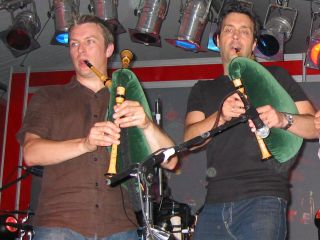
Another development of piping in Wales has been the making of mouth blown pibau cwd, pibgwd or bacbib which are based on the veuze and Galician gaita. They have a steep conically bored chanter with seven finger holes and thumb hole with a double reed and a single base drone usually tuned two octaves below the tonic. Drones are also tuned to one note below the tonic for minor tunes. Welsh pipers most often play bagpipes in the key of D but other keys are also used, particularly C or B#.
Welsh pipe groups/bands include Pibau Pencader, Pibe Bach, Pibau Preseli, and Bagad Pibau Morgannwg.
Welsh musicians/groups using pigyrn, pibe cwd etc. include Fernhill, Carreg Lafar, Crasdant, Stephen Rees and Andy Mclaughlin, Jason Lawday, and Antwn Owen Hicks and Gafin Morgan, Rhodri Smith and Gerard KilBride, Triban.

 From Wikipedia, the free encyclopedia
[en.wikipedia.org/wiki/Music_of_Wales,
eTriple_harp,
Crwth,
Welsh_Bagpipes,
Pibgorn_(instrument)].
All text is available under the terms of the
GNU Free Documentation License.
Date: June 2009.
From Wikipedia, the free encyclopedia
[en.wikipedia.org/wiki/Music_of_Wales,
eTriple_harp,
Crwth,
Welsh_Bagpipes,
Pibgorn_(instrument)].
All text is available under the terms of the
GNU Free Documentation License.
Date: June 2009.
|
Photo Credits:
(1) Welsh Flag (unknown);
(2) Ar Log,
(3) Crasdant,
(6) Crwth
(7) Antwn Owen Hicks & Gafin Morgan
(by Wikipedia);
(4) Gwenan Gibbard,
(8) Carreg Lafar
(from website);
(5) Cass Meurig
(by Walkin' Tom).
|
To the German FolkWorld |
© The Mollis - Editors of FolkWorld; Published 07/2009
All material published in FolkWorld is © The Author via FolkWorld. Storage for private use is allowed and welcome. Reviews and extracts of up to 200 words may be freely quoted and reproduced, if source and author are acknowledged. For any other reproduction please ask the Editors for permission. Although any external links from FolkWorld are chosen with greatest care, FolkWorld and its editors do not take any responsibility for the content of the linked external websites.


 @
@