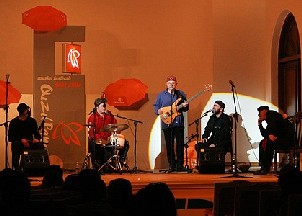
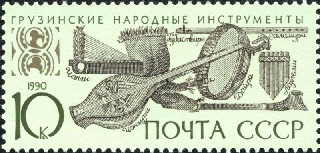
ÿþ<html> <head><title>FolkWorld Article: Music of Georgia</title></head> <body bgcolor="#FFF2E6" link="#DC143C" alink="#FF3300" vlink="#4B0082"> <p><font size=4 color="4169e1"><font FACE="Maiandra GD">FolkWorld</font> Issue 37 11/2008; Article from Wikipedia, the free encyclopedia </font> </p> <center> <p><b><font color="#ff0000" size="7">Music of Georgia</font><br> <font color="#008000" size="3">From Wikipedia, the free encyclopedia</font> </b></p> </center> <p><font size=4> In August 2008, the former Soviet Republic of Georgia engaged in an armed conflict with Russia and separatist groups in South Ossetia and Abkhazia. The unresolved secessionist conflicts and the tense relations with Russia make us forget that Georgians are renowned for their love of music and dance, and that Georgia is well known for its rich folklore and its unique traditional music. </font></p> <p><table align="right" bgcolor="#ffebcd" cellpadding=5 width=255 border=5 bordercolor="#FFF2E6"> <tr><td> <center> <img src="../p/georgiamap.jpg" width=259 height=246 border=1 alt="Georgia Map"> <br><b>Georgia (áÐåÐà×ÕÔÚÝ, Sakartvelo)</b><br></center> <font size=-1><br> <img src="../../p/georgia.gif" width=96 height=64 border=1 alt="Georgia Flag" align=right> <b>Capital:</b> Tbilisi <br><b>Population:</b> 4,5 mio <br><b>Location:</b> Georgia is a country in the Caucasus region in Southwestern Asia. Georgia is bordered to the north by the Russian Federation, to the east by Azerbaijan, to the west by the Black Sea, to the south by Armenia and Turkey.</font> </td></tr> </table> <P><A id=Folk_music name=Folk_music></A></P> <H2><SPAN class=mw-headline>Folk music</SPAN></H2> <P>Georgian folk music possesses what is the oldest tradition of <A title=Polyphony href="http://en.wikipedia.org/wiki/Polyphony">polyphonic</A> music in the world, predating the <A title="History of Georgia (country)" href="http://en.wikipedia.org/wiki/History_of_Georgia_(country)#Ancient_Georgia">introduction of Christianity</A>.</P> <P><A id=Tuning name=Tuning></A></P> <H3><SPAN class=mw-headline>Tuning</SPAN></H3> <P><A title="Musical scale" href="http://en.wikipedia.org/wiki/Musical_scale">Scales</A> used in traditional Georgian music have, like most European scales, octaves divided into seven tones (eight including the octave), but the spacing of the tones is different. As with most traditional systems of tuning, traditional Georgian folk music uses a <A title="Just intonation" href="http://en.wikipedia.org/wiki/Just_intonation">just</A> <A title="Perfect fifth" href="http://en.wikipedia.org/wiki/Perfect_fifth">perfect fifth</A>. Between the unison and the fifth, however, come three evenly-spaced notes, producing a compressed (compared to most European music) <A title="Major second" href="http://en.wikipedia.org/wiki/Major_second">major second</A>, a <A title="Neutral third" href="http://en.wikipedia.org/wiki/Neutral_third">neutral third</A>, and a stretched <A title="Perfect fourth" href="http://en.wikipedia.org/wiki/Perfect_fourth">perfect fourth</A>. Likewise, between the fifth and the octave come two evenly-spaced notes, producing a compressed <A title="Major sixth" href="http://en.wikipedia.org/wiki/Major_sixth">major sixth</A> and a stretched <A title="Minor seventh" href="http://en.wikipedia.org/wiki/Minor_seventh">minor seventh</A>. This system of tuning renders thirds as the most <A class=mw-redirect title="Consonance (music)" href="http://en.wikipedia.org/wiki/Consonance_(music)">consonant</A> interval after fifths, which resulted in the third being treated as a stable interval in Georgia long before it acquired that status in Western music. <P>Some consider the Georgian scale a "quintave system" (as opposed to the octave-repeating "octave system"). Due to the neutral tuning within the quintave system, the eighth degree or octave is slightly widened, which often results in a rise in pitch from the beginning of a song to the end.</P> <P>Because of the influence of the Western music and its different system of tuning, present-day performances of Georgian folk music often employ Western tuning, bringing the seconds, fourths, sixths, and sevenths, and sometimes the thirds as well, closer to where they would lie in a Western scale.</P> <P><A id=Musical_literature_and_traditions name=Musical_literature_and_traditions></A></P> <H3><SPAN class=mw-headline>Musical literature and traditions</SPAN></H3> <a name="theshin"></a> <table align="left" bgcolor="#ffebcd" cellpadding=5 width=255 border=5 bordercolor="#FFF2E6"> <tr><td> <img src="../p/shin.jpg" width=302 height=216 border=0 alt="The Shin"> <p><font size=-1> <b>The Shin</b>, in their search for a sound that is definitively Georgian, have created a trans-regional fusion of various Georgian styles. Their project <i>EgAri</i> is based on Georgian instrumental music, traditional polyphonic vocals, and folk dance, and unites for the first time these quite separate segments of Georgian culture. </font> <p><b>The Shin @ FolkWorld:</b> <a href="../../34/e/cds6.html#shin">FW #34</a> <p><IMG SRC="../../p/icon_movie_kl.gif" height=19 width=26 alt="Icon Movie"> <a HREF="http://www.youtube.com/watch?v=HE0Gu7C1O6w">Chips On The Water</a>, <a HREF="http://www.youtube.com/watch?v=AGHR7tNpBok">Epic Waltz of Mr QQ</a> <p><center><a HREF="http://www.theshin-music.com"><b>www.theshin-music.com</a></b></center> </td></tr> </table> <P>Georgian folk songs are often centered on feasts called <I>supra</I>, where songs and toasts to God, fatherland, long life, love and other topics. Traditional feast songs include "Zamtari", which is about winter and is sung to commemorate ancestors, and "Mravalzhamier", a joyous hymn. <A title="Work song" href="http://en.wikipedia.org/wiki/Work_song">Work songs</A> are also widespread. The orovela, for example is a type of work song found in eastern Georgia. There is also a distinct and rich tradition of Georgian sacred music, both settings of hymns for the Orthodox Church, and folk hymns and ritual songs that contain a great deal of "pagan" imagery. There are, in addition, many lyric love songs, dance songs, lullabies, and travelling songs, among others.</P> <P>Choirs are generally entirely male, though some female groups also exist; mixed-gender choirs are rare, but also exist. (An example of the latter is the Zedashe ensemble, based in <A title=Sighnaghi href="http://en.wikipedia.org/wiki/Sighnaghi">Sighnaghi</A>, <A title=Kakheti href="http://en.wikipedia.org/wiki/Kakheti">Kakheti</A>.)</P> <P><A id=Varieties_within_the_country name=Varieties_within_the_country></A></P> <H3><SPAN class=mw-headline>Varieties within the country</SPAN></H3> <P>Georgia is a small country, but it is very mountainous. For this reason, folk music styles from different regions of Georgia differ very widely, which makes it difficult to speak of characteristics of "Georgian folk music" as a monolithic whole.</P> <P>Table songs from <A title=Kakheti href="http://en.wikipedia.org/wiki/Kakheti">Kakheti</A> in eastern Georgia usually feature a simple, drone-like bass part with two soloists singing the top two parts. Kakhetian melodies sound like recitative part of the time (with great emphasis on the words, which are highly poetic), and then break into series of ornate, cascading ornaments. The two melody parts do play off each other, but there is not the type of complicated back-and-forth between the parts that one hears in Gurian trio songs. Perhaps the most well-known example of music in Kakhetian style is the patriotic "Chakrulo", which was chosen to accompany the <I><A title="Voyager program" href="http://en.wikipedia.org/wiki/Voyager_program">Voyager</A></I> spacecraft in 1977.</P> <P>In Rach'a and Ajara, male singers accompany themselves on bagpipe. <A title="Consonance and dissonance" href="http://en.wikipedia.org/wiki/Consonance_and_dissonance">Dissonance</A> is prominent in the west, in <A class=mw-redirect title=Mingrelia href="http://en.wikipedia.org/wiki/Mingrelia">Mingrelia</A> and <A title=Guria href="http://en.wikipedia.org/wiki/Guria">Guria</A>, which also features high pitches and outrageous, <A class=mw-redirect title=Yodelling href="http://en.wikipedia.org/wiki/Yodelling">yodelling</A>-like vocals called krimanchuli. <A title=Svaneti href="http://en.wikipedia.org/wiki/Svaneti">Svaneti</A>'s traditions are perhaps the oldest and most traditional due to the region's isolation. Svan harmonies are irregular and angular, and the middle voice leads two supporting vocals, all with a narrow range. The 20th century has seen professional choirs achieve renown in Georgia, especially Anzor Erkomaishvili's <A title="Rustavi Choir" href="http://en.wikipedia.org/wiki/Rustavi_Choir">Rustavi Choir</A>.</P> <P><A id=Contemporary_Georgian_music name=Contemporary_Georgian_music></A></P> <H2><SPAN class=mw-headline>Contemporary Georgian music</SPAN></H2> <img src="../p/georgian.jpg" width=320 height=153 border=0 hspace=10 vspace=10 alt="Georgian Instruments" align=right> <P>Georgia is home to a form of <A class=mw-redirect title="Urban music" href="http://en.wikipedia.org/wiki/Urban_music">urban music</A> with sentimental, lovelorn lyrics, as well as a more rough and crude urban music featuring <A title=Clarinet href="http://en.wikipedia.org/wiki/Clarinet">clarinets</A>, <A title="Nagara (drum)" href="http://en.wikipedia.org/wiki/Nagara_(drum)#Doli">doli</A> and <A title=Duduk href="http://en.wikipedia.org/wiki/Duduk">duduks</A>.</P> <P><A id=Folk_musical_instruments name=Folk_musical_instruments></A></P> <H2><SPAN class=mw-headline>Folk musical instruments</SPAN></H2> <P><A class=mw-redirect title="Wind instruments" href="http://en.wikipedia.org/wiki/Wind_instruments">Wind instruments</A>: larchemi-soinari, salamuri, pilili, gudastviri and stviri</P> <P>Brass wind instruments: sankeri</P> <P><A class=mw-redirect title="String instruments" href="http://en.wikipedia.org/wiki/String_instruments">String instruments</A>: panduri, chonguri, chunir, chianuri and changi</P> <P><A class=mw-redirect title="Percussion instruments" href="http://en.wikipedia.org/wiki/Percussion_instruments">Percussion instruments</A>: doli, daira and diplipito</P> <table bgcolor="#ffebcd" cellpadding=10 border=20 bordercolor="#FFF2E6" align=right width=550> <tr><td> <P><A id=References name=References></A></P> <H2><SPAN class=mw-headline>References</SPAN></H2> <UL> <LI>Broughton, Simon. "A Feast of Songs". 2000. In Broughton, Simon and Ellingham, Mark with McConnachie, James and Duane, Orla (Ed.), <I>World Music, Vol. 1: Africa, Europe and the Middle East</I>, pp 347-350. Rough Guides Ltd, Penguin Books. <A class=internal href="http://en.wikipedia.org/wiki/Special:BookSources/1858286360">ISBN 1-85828-636-0</A> <LI><A class="external text" title=http://georgianwines.blogspot.com/2007/04/ancient-music-accompanies-ancient-wine.html href="http://georgianwines.blogspot.com/2007/04/ancient-music-accompanies-ancient-wine.html" rel=nofollow>"Ancient Music Accompanies Ancient Wine," <I>From the Cradle of Wine</I></A> <LI><A class="external autonumber" title=http://www.georgian-music.com href="http://www.georgian-music.com/" rel=nofollow>[1]</A> Listen to streaming Georgian music of different genres, read bios, lyrics, download scores for free, learn descriptions of folk songs, some facts from Georgian music history. <LI><A class="external text" title=http://www.polyphony.ge/en/homepage/home.php href="http://www.polyphony.ge/en/homepage/home.php" rel=nofollow>Traditional Polyphony of Georgia</A>, a <A title=UNESCO href="http://en.wikipedia.org/wiki/UNESCO">UNESCO</A>-sponsored project. </LI></UL> <P><A id=See_also name=See_also></A></P> <H2><SPAN class=mw-headline>See also</SPAN></H2> <UL> <LI><A title=Suliko href="http://en.wikipedia.org/wiki/Suliko">Suliko</A> <LI><A title=Iavnana href="http://en.wikipedia.org/wiki/Iavnana">Iavnana</A> </LI></UL> </td></tr> </table> <UL> <LI>Chuniri <LI><A class=mw-redirect title=Chiboni href="http://en.wikipedia.org/wiki/Chiboni">Chiboni</A> <LI><A title=Çeng href="http://en.wikipedia.org/wiki/%C3%87eng">Changi</A> <LI><A title=Pandura href="http://en.wikipedia.org/wiki/Pandura">Panduri</A> <LI>Chonguri <LI>Salamuri <LI><A class=mw-redirect title=Duduki href="http://en.wikipedia.org/wiki/Duduki">Duduki</A> <LI><A class=mw-redirect title="Nagara (Drum)" href="http://en.wikipedia.org/wiki/Nagara_(Drum)#Doli">Doli</A> <LI>Diplipito <LI><A title=Dayereh href="http://en.wikipedia.org/wiki/Dayereh">Daira</A> <LI><A title=Tsintsila href="http://en.wikipedia.org/wiki/Tsintsila">Tsintsila</A> <LI>Buki <LI><A title="Tulum (bagpipe)" href="http://en.wikipedia.org/wiki/Tulum_(bagpipe)">Gudastviri</A> <LI><A title=Zurna href="http://en.wikipedia.org/wiki/Zurna">Zurna</A> <LI>Pilili <LI>Garmoni <LI>Tsiko-tsiko <LI>Buzika </LI></UL> <P><A id=Georgian_hip_hop name=Georgian_hip_hop></A></P> <H2><SPAN class=mw-headline>Georgian hip hop</SPAN></H2> <DL> <DD> <DIV class="noprint relarticle mainarticle"><I>Main article: <A title="Georgian hip hop" href="http://en.wikipedia.org/wiki/Music_of_Georgia#Georgian_hip_hop">Georgian hip hop</A></I></DIV></DD></DL> <br clear=all> <table bgcolor="#ffebcd" align=center width=585 cellpadding=10 border=20 bordercolor="#FFF2E6"> <tr><td> <img src="../../35/p/wiki.jpg" width=128 height=96 border=1 alt="" align=right hspace=10> <img src="../../35/p/gnu.gif" width=100 height=98 border=1 alt="" align=left hspace=10> <font size=-1><i> From <a href="http://en.wikipedia.org">Wikipedia, the free encyclopedia</a> [<a href="http://en.wikipedia.org/wiki/Music_of_Georgia">en.wikipedia.org/wiki/Music_of_Georgia</a>].<br> All text is available under the terms of the <a href="http://en.wikipedia.org/wiki/GNU_FDL">GNU Free Documentation License</a>.<br><br> Date: October 2008. </i></font></td></tr> </table> <p><font size=-1><b>Photo Credits:</b><i> (1) Map, (2) Georgian Flag, (4) Soviet postage stamp depicting traditional musical instruments of Georgia, (6) Wikipedia Logo (by <a href="http://en.wikipedia.org">Wikipedia</a>); (3) <a HREF="http://www.theshin-music.com">The Shin</a> (from website); (5) GNU Logo (by <a href="http://www.gnu.org/">GNU Project</a>). </i></font> <br><br> <hr color="#ff0000"> <p><table align="center" bgcolor="#ffebcd" cellpadding=20 border=5 bordercolor="#FFF2E6"> <tr><td> <p><center> <font size=4> <a HREF="index.html#up">Back to FolkWorld Content</a><br> <a HREF="../d/index.html#up">To the German FolkWorld</a> </font> </center> </td></tr> </table> <p> <font size=-1>&#169 <a HREF="../../fw/staff.html">The Mollis</a> - Editors of <font face="Maiandra GD">FolkWorld</font>; Published 11/2008</font> <p><FONT FACE="Arial" SIZE=-2>All material published in FolkWorld is &#169 The Author via FolkWorld. Storage for private use is allowed and welcome. Reviews and extracts of up to 200 words may be freely quoted and reproduced, if source and author are acknowledged. For any other reproduction please ask the Editors for permission. Although any external links from FolkWorld are chosen with greatest care, FolkWorld and its editors do not take any responsibility for the content of the linked external websites. </font> <hr color="#0000CD"> <CENTER> <FONT FACE="Arial" SIZE=-2>FolkWorld - Home of European Music</FONT><BR> <A HREF="http://www.folkworld.eu/"><IMG SRC="../../p/fw.jpg" WIDTH="360" HEIGHT="54" BORDER="0" ALT="FolkWorld Home"></A> <BR> <FONT FACE="Arial" SIZE=-2>Layout &amp; Idea of FolkWorld &#169 <a HREF="../../fw/staff.html">The Mollis</a> - Editors of FolkWorld</FONT> </CENTER> </body> </html>